
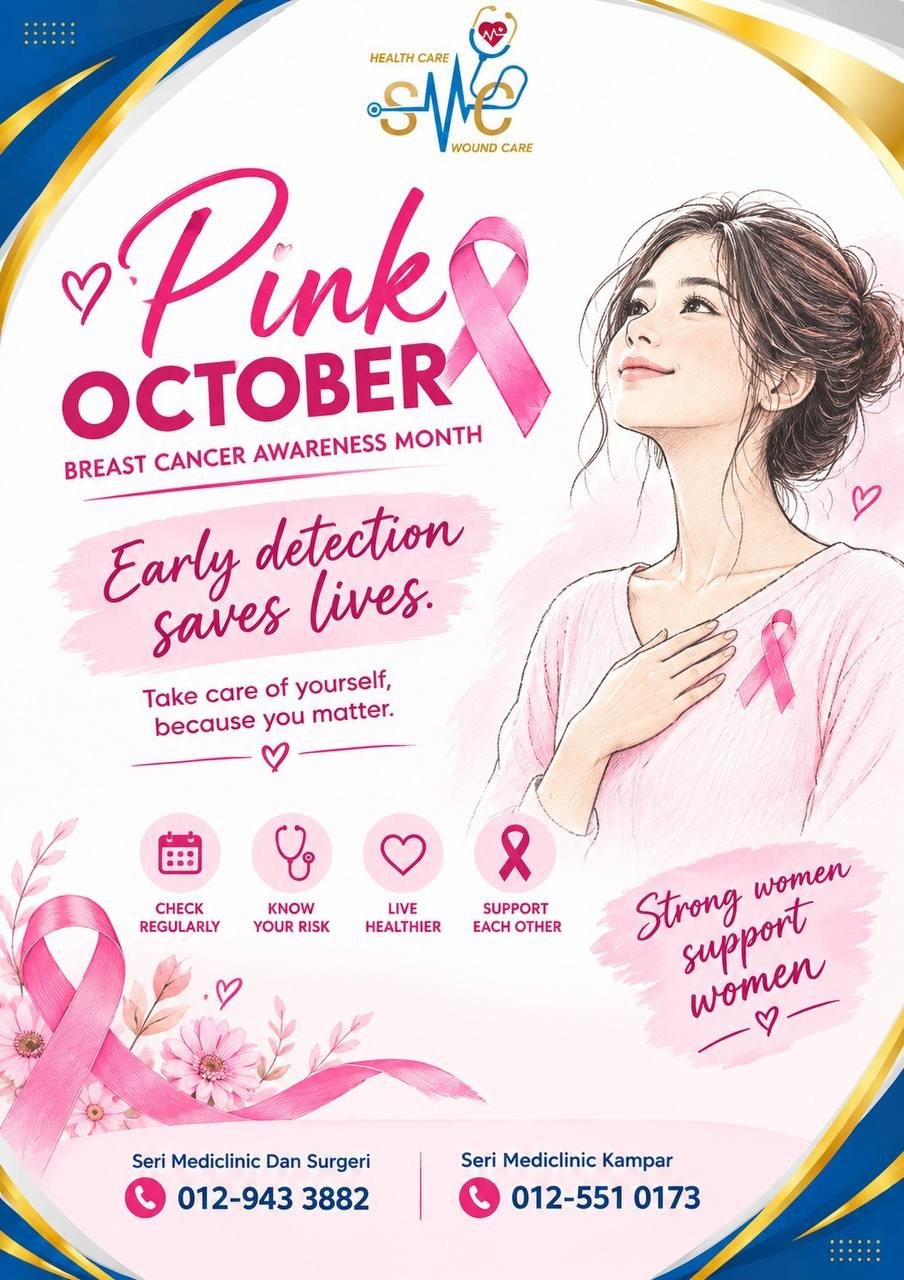
October is observed worldwide as Pink October, Breast Cancer Awareness Month. The pink ribbon carries one practical message: breast cancer is generally easier to manage, and outcomes are better, when it is found at an early stage.
In Malaysia, breast cancer is the most common cancer among women, and about half of breast cancers with a recorded stage are still diagnosed late (stage III or IV), sometimes after a change was put off or ignored, or without any screening. That is why the message on the Pink October poster from Seri Mediclinic, shared across the Silibin (Ipoh) and Kampar branches, is a simple one: early detection saves lives, and taking care of yourself matters.
This guide follows the four reminders on that poster: check regularly, know your risk, live healthier and support each other. It also explains which breast changes are worth having looked at, how screening works, and what a GP can and cannot do as a first point of contact.
What Pink October and Breast Cancer Awareness Month Are About
Pink October is an annual awareness month that draws attention to breast cancer through education, early-detection messages and community support. It is not only for women who are unwell or at high risk. It is a prompt for every woman, and for the people around her, to learn what is normal, understand personal risk, keep screening up to date and talk openly about breast health, something many people still find uncomfortable.
Check Regularly: Know What Is Normal for You
Breasts vary widely from woman to woman, and they change with the menstrual cycle, pregnancy, breastfeeding and menopause. Many women have breasts that feel lumpy or tender at certain points in the month. The aim of being “breast aware” is not to hunt for problems, but to know your own normal so that a new or persistent change stands out.
Many women find it helpful to check once a month. A good time is a few days after a period ends, when the breasts are usually less tender. If you no longer have periods, pick a fixed date each month so it becomes a habit. A simple routine:
- Look: stand in front of a mirror with your arms by your sides, then raised overhead. Notice the size, shape, skin and nipples.
- Feel: using the flat pads of your fingers, move in small circles or up-and-down lines to cover the whole breast, from the collarbone down to the bra line and out to the underarm. Many women do this lying down, and some prefer the shower.
- Compare: left and right will rarely match perfectly. What matters is a change from your usual.
Self-checks complement, rather than replace, a doctor’s examination and screening mammograms, because many early cancers cannot be felt at all.
Changes worth getting checked
The following changes are worth having looked at by a doctor:
- A new lump or thickened area in the breast or underarm, whether or not it hurts (many breast cancer lumps are painless)
- A change in the size or shape of the breast
- Dimpling, puckering or skin that looks like orange peel
- Redness, scaling or a rash on the breast or around the nipple
- A nipple that has newly turned inward
- Nipple discharge that is not breast milk, especially if it is bloody or comes from one breast only
- Swelling or heaviness of part or all of the breast, even without a distinct lump
- Persistent pain in one spot that does not settle
Most breast lumps turn out to be benign, such as cysts or fibroadenomas, but a lump cannot be judged harmless by touch alone. A proper assessment, which may include imaging and referral to a breast specialist, is the only way to know, and the sooner a change is looked at, the sooner reassurance or the next step can follow.
Know Your Risk
No one can say for certain who will develop breast cancer, but some factors raise or lower the likelihood.
Factors that cannot be changed
- Age: risk rises as women get older
- Family history: a mother, sister or daughter with breast or ovarian cancer, particularly at a young age, or a known BRCA1 or BRCA2 gene change in the family
- Personal history: a previous breast cancer, certain breast conditions found on biopsy, or earlier radiation therapy to the chest at a young age
- Hormonal timeline: periods that started early (before about age 12) or menopause that started late (after about age 55)
Factors that can be influenced
- Excess body weight, especially after menopause
- Low physical activity
- Alcohol intake
- Long-term use of combined hormone therapy after menopause, which is worth discussing with a doctor
- Not breastfeeding, since breastfeeding is linked with a modest reduction in risk
Having one or more risk factors does not mean cancer will develop, and many women who do develop breast cancer have no obvious risk factors at all. Being a woman and growing older are the biggest influences, but breast cancer is not only a disease of older women: in Malaysia a sizeable share of cases are found in women in their 30s, 40s and early 50s, so being younger is not a reason to ignore a change. Men can also develop breast cancer, although it is uncommon, and the same advice about checking any new lump applies.
If a close relative has had breast or ovarian cancer, it is worth telling a doctor. Family history can change when screening should begin and how often it is done, and some families are referred to a specialist for further risk assessment.
Screening: Finding Changes Before They Can Be Felt
Screening means checking women who have no symptoms, so that cancer can be found at an early, more manageable stage.
- Mammogram: a low-dose X-ray of the breast that can pick up changes years before a lump can be felt. In Malaysia, guidance differs a little by source. The Ministry of Health guideline supports mammography every two years for women aged 50 to 74 at average risk, and says women in their 40s can discuss the benefits and limits of screening with a doctor, with annual screening from age 40 for those at moderate or higher risk. The National Cancer Society Malaysia encourages women from 40 to have regular mammograms. Women with a strong family history may be advised to start earlier.
- Breast ultrasound: not a screening test on its own. It is used to look more closely at a lump that has been felt or an area seen on a mammogram, and is often the first scan used to assess a lump in younger women, whose denser breast tissue can make mammograms harder to read.
- Clinical breast examination: a doctor examines the breasts and underarms, which can be done during a routine consultation.
It helps to be clear about roles. A GP is usually the first point of contact: taking a history, examining the breasts, explaining risk, advising whether imaging is appropriate and referring onward. Mammograms are usually carried out at imaging centres and hospitals, and breast ultrasound at imaging centres, hospitals and some clinics. Any abnormal result is followed up by a breast specialist or surgeon. Confirming a diagnosis and providing cancer care take place in hospitals and specialist centres, not in a general practice clinic.
The right screening plan differs from person to person, so it is worth discussing in a consultation rather than assuming. Related background reading: health screening after 40 and when to see a women’s health doctor in Ipoh.
Live Healthier
Healthy habits do not eliminate the risk of breast cancer, but they are linked with lower risk and with better health overall:
- Keep a healthy weight, especially after menopause
- Stay active: around 150 minutes of moderate activity a week, such as brisk walking, is a common target
- Limit alcohol, and avoid smoking
- Eat plenty of vegetables, fruit and whole grains, and go easier on sugary drinks and heavily processed foods
- Breastfeed if you are able to and it suits your circumstances
- Talk to a doctor before starting or continuing long-term hormone therapy
Because lifestyle only lowers risk and never eliminates it, healthy living should sit alongside regular checks and screening, not replace them.
Support Each Other
“Strong women support women” is also a line on the campaign poster, and it is practical advice as well as a slogan.
- Remind the women in your life, whether a mother, sister, friend or colleague, to keep up with their own checks. Many women look after everyone else first.
- Volunteer to go along to an appointment or a mammogram. Having company makes it easier to turn up.
- If someone you know is facing a diagnosis, practical help counts: lifts to appointments, meals, help with childcare, or simply time to listen. Give support rather than opinions, and avoid pushing untested remedies.
- Speak openly. Silence and embarrassment are among the reasons breast changes go unchecked for months.
For women and families living with breast cancer, support groups and counselling are available through hospitals and organisations such as the National Cancer Society Malaysia.
When to See a Doctor
It is reasonable to see a doctor, whatever the time of year and even if a change is painless, if you notice:
- Any of the changes listed above
- A new lump, which is worth having checked within a couple of weeks rather than left to see whether it settles
- A lump or change, if you have a family history of breast or ovarian cancer
- Uncertainty about when to start screening, or whether your family history matters
A GP is a sensible first point of contact. A doctor can ask about your history, examine your breasts, advise whether imaging is needed and refer you to a breast specialist where appropriate. Most changes turn out to be harmless, and an early check is how that is confirmed.
Related reading: women’s health in Kampar: screening and what to expect.
Frequently Asked Questions
Is every breast lump cancer?
No. Most breast lumps are not cancer. Cysts, fibroadenomas and normal changes linked to the menstrual cycle are common causes. However, a lump cannot be judged harmless just by how it feels, so any new or persistent lump should be checked by a doctor.
At what age should breast cancer screening start?
Malaysian guidance varies a little by source. The Ministry of Health guideline supports mammography every two years from age 50 to 74 for women at average risk, and says women in their 40s can discuss screening with a doctor, with annual screening from age 40 for those at moderate or higher risk. The National Cancer Society Malaysia encourages regular mammograms from age 40. Women with a strong family history may be advised to begin earlier. Breast awareness, knowing what is normal for you, applies at any adult age. The right plan for you is worth working out with a doctor.
Does having no family history mean I am not at risk?
No. Most women who develop breast cancer have no close relative with the disease. Age and being a woman are the biggest risk factors, so screening and prompt checking of any change matter for everyone.
What should I do if I find a lump?
Stay calm and avoid squeezing, massaging or applying home or herbal remedies to it. Note when you first noticed it and whether it changes with your menstrual cycle, then see a doctor for an examination. The doctor can advise whether imaging or a referral to a specialist is needed.
Is a mammogram painful or safe?
A mammogram compresses the breast briefly, which can be uncomfortable but lasts only a few seconds for each image. The radiation dose is low, and the benefit of finding cancer early is considered to outweigh the very small risk. Choosing a time when the breasts are less tender, such as the week after a period, can help.
This article is general health information and does not replace individual medical advice. For further information, you are welcome to call 012-943 3882 (Silibin, Ipoh) or 012-551 0173 (Kampar), or walk in during opening hours.